

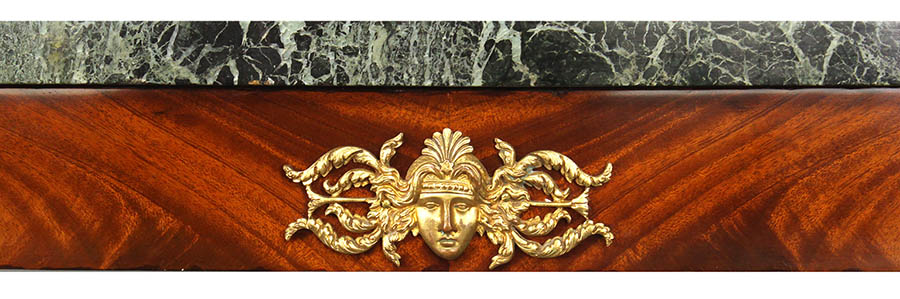
Description:
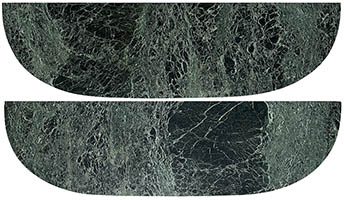
A Fine Pair of French 19th/20th Century Empire Revival Style Exotic Mahogany Marquetry and Gilt-Bronze Wall Mounting Demi-Lune Consoles fitted with green d'Alps marble tops, attributed to Maison Forest, Paris. Circa: Paris, 1890-1900.
Maison Forest, founded in 1883, operated from 14 Rue Pierre-Picard and 31 Rue Cambacérès in Paris. Renowned for its exceptional craftsmanship, the esteemed fine furniture manufacturer produced high-quality furniture and decorative art pieces during the late 19th and early 20th centuries. Specializing in Louis XIV, Louis XV, Louis XVI, Empire, and Napoleon III styles, Maison Forest's exquisite furnishings, often adorned with fine ormolu mounts, catered to a discerning international clientele.
Height: 39 inches (99.1 cm)
Width: 55 inches (139.7 cm)
Depth: 16 inches (40.6 cm)
Ref.: A2870


Luigi Ciampaglia held the position of head artisan at the Fonderia (Foundry) Chiurazzi di Napoli. Established by Gennaro Chiurazzi (1840–1906), the Fonderia Chiurazzi originated from a modest foundry founded in Naples in 1870. It swiftly gained renown, expanding into a workshop within the Albergo dei Poveri, where a team of skilled craftsmen, known as formatori, diligently produced casts of numerous statues. Over time, the foundry secured the privilege of taking molds from prestigious collections, including those of the Museo Archeologico Nazionale in Naples, the Capitoline Museums, the Vatican, the Borghese Gallery in Rome, and the Palazzo Pitti and the Uffizi Gallery in Florence. This resulted in the creation of over fifteen hundred plaster piece molds, embodying the century-long legacy of the company—a feat that remains unparalleled today. Chiurazzi bronzes, exemplified by the series of replicas of statues from the Villa dei Papiri commissioned for the Getty Villa in Malibu during the early 1970s, can be found across the globe, showcasing the enduring impact of their craftsmanship.
A crucial factor contributing to the foundry's remarkable success was its adherence to traditional techniques, notably the utilization of the lost-wax method, as opposed to the more prevalent sand casting of the era. This meticulous approach ensured the faithful reproduction of the original sculptures. Sale catalogues issued by the foundry throughout the twentieth century reveal that, in addition to offering their products in various sizes, the company provided them with a selection of patinas: Pompeii (green), Herculaneum (dark), and Renaissance (shiny bronze), further enhancing the appeal and versatility of their offerings.
Luigi Ciampaglia was responsible for creating the large castings of the quadrigae featured on the memorial to Victor Emmanuel II in Piazza Venezia, Rome. Two notable specimens were produced for this occasion: the first, crafted in dark polished bronze, is currently housed at The Civico Museo d'Arte Contemporanea in Milan, while the second, made of highly polished, copper-plated brass, resides at the Museum of Modern Art in New York, NY.
The original plaster model of these quadrigae was owned by the Marinetti family until 1952, when it was acquired by Francisco Matarazzo Sobrinho for the museum of the University of Sao Paulo, Brazil. One of the initial two castings, completed in 1931 by Luigi Ciampaglia on behalf of the Galleria Chiurazzi, is crafted in dark polished bronze and is now showcased in the Galleria Civica in Milan. The other casting, made of white metal, was procured by the Museum of Modern Art in New York in 1947.
In 1949, the Nicci brothers, Giovanni and Angelo, produced two rough bronzes with a light brown patina. One of these bronzes was acquired by the Kunsthaus in Zurich, while the other, belonging to the Marinetti family, was sold in 1956 to Harry and Lydia Winston and now forms part of the Lydia Winston Malbin Collection in New York.
The Ciampaglia Foundry, situated in Naples, held significant prominence in artistic production, particularly in the casting of bronze sculptural works. One renowned sculptor associated with this foundry is Luigi de Luca. Born in Naples in 1855, de Luca was a talented artist of the late nineteenth century, whose creations reflect the collecting trends of that era and his fervent dedication to artistry. De Luca honed his craft under the tutelage of the master realist Stanislao Lista, who instilled in him a keen eye for observing reality and shaping works inspired by life itself.
Within the Museum and Royal Bosco of Capodimonte, four pieces by Luigi de Luca are carefully preserved, each acquired at different times through purchases or commissions of definitive versions based on original models. Notably, among these sculptures is a terracotta piece patinated to resemble bronze, titled "Vanished Illusions - Prodigal Son."
Another notable work by de Luca housed in the museum is the "Slave for Sale," created in 1893. This piece, cast in bronze at the Ciampaglia foundry in Naples, joined the Capodimonte collection in the twentieth century through a ministerial acquisition.
These sculptural works serve as captivating links between art and history, showcasing the intertwined narratives that have shaped Naples' artistic heritage. The Ciampaglia Foundry's role in preserving and disseminating this cultural legacy is indeed significant.
LITERATURE:
Museo e Real Bosco di Capodimonte:
Fonderia Stroica Chiurazzi and Luigi Ciampaglia - Literature
From Academia.edu:
The Chiurazzi Sculpture Collection at the John and Mable Ringling Museum of_Art, Sarasota, Florida
From Wothpoint:
Fonderia Chiurazzi and Luigi Ciampaglia - Futurist Conditions: Imagining Time in Italian Futurism
From Ringling Docents:
The Chiurazzi Foundry History
From the book:
Futurist Conditions: Imagining Time in Italian Futurism


 Facebook
 Twitter
 Linked In
 Pinterest